


Public welfare hotline:+86-010-84404273
Email: apepcy@apepcy.org

On the eve of the 38th World AIDS Day, the nation’s first public welfare film focusing on adolescent AIDS prevention and education, Changier, held its national premiere in Beijing on the 28th. Representatives from international institutions including the World Health Organization, UNAIDS, UNICEF, and UNESCO, as well as teachers and students from nine universities such as Peking University and Tsinghua University, Changier Hut partners, volunteers, media reporters, and more than ten news outlets—over 700 attendees in total—gathered to witness this meaningful moment.

Producer, screenwriter and director of the film, Xiang Kai (first from left), chief planner Zhang Yinjun (center), together with executive producer Li Yanjun (first from right), Xiang Neng and other members of the creative team, shared the filmmaking journey and the story behind the creation of Changier. Distinguished guests from various sectors offered interpretations of the film’s significance from different perspectives. “There are no bad children, only unfortunate ones. We record regrets through the camera so that there will be fewer regrets in real life,” said Xiang Kai emotionally. During the production, the creative team was once led deep into the Red Ribbon School in Linfen, Shanxi Province. The script went through nine rounds of revisions to ensure an authentic and truthful representation.
The film is the result of six years of dedicated refinement and embodies the invaluable experience accumulated from 20 years of public welfare practice. Based on real-life stories, the film presents a major breakthrough in China’s AIDS prevention and education efforts—demonstrating both remarkable technological progress and profound humanistic care. This work opens a new path for adolescent health education and represents a dual advance in professional practice and social compassion. The film was selected as a recommended work in the “Light and Shadow Imprint” section of the 14th Beijing International Film Festival.
Changier at 20:"Protect Every Child"

Chief Planner of the film and Chairperson of the Beijing Changier Education Foundation, Zhang Yinjun, said that despite knowing there would be no box office returns, the team still devoted six years to bringing the film to the public with one simple belief—if people want to protect their own children, they must protect every child. Speaking emotionally about the film, Zhang Yinjun noted: “The film Changier is a message of love, a dialogue of hearts, and a sincere call about life and responsibility. It is not only created for children, but also for parents, educators, and the whole society. Only when children have a promising future can the nation have a future, and everyone have a future. That is why I am full of confidence and hope.”

Mr. Gu Mingyuan, leader of the APEPCY Leadership Group and a renowned educator at the age of 97, wrote an inscription for the film’s premiere: “Lights and Shadows Reflect the Original Aspiration, Changier Warms the Nation.” After watching the film, he expressed with deep emotion: “Using cinema as a way to spread AIDS prevention knowledge and to tell stories about AIDS prevention can awaken vigilance and awareness in every heart. This is the starting point of the APEPCY, and it is also the long-cherished dream of the project.” Gu Mingyuan highly praised the film as “a work filled with the beauty of humanity and shining with the spirit of the Chinese nation—whenever one place faces difficulties, support comes from all directions, uniting everyone with shared determination.” He also voiced an earnest expectation: “May more teachers, students, and parents come to watch this meaningful film, and may the warmth of Changier be delivered to every corner of the world that longs for love.”

CCTV host and China Media Group presenter Bai Yansong, the first Image Ambassador of AIDS Prevention Education Project for Chinese Youth (APEPCY), reflected in his address: “We hope that love can act like a relay baton and help build a stronger line of defense in AIDS prevention.” He further pointed out that this year marks the 40th anniversary of the first confirmed AIDS case in China. Over the past decades, China’s achievements in AIDS prevention have drawn global attention, and the film Changier represents a social practice of collaborative governance in AIDS prevention initiated by civil society and supported by the joint participation of multiple sectors.

Current Image Ambassador of AIDS Prevention Education Project for Chinese Youth (APEPCY), Kang Hui, delivered a video message: “This film is not only a courageous attempt to bring public welfare ideals onto the big screen, but also a genuine echo of APEPCY’s 20 years of grassroots dedication.” He appealed for every child to grow up healthy, confident, and with dignity in the sunshine of love, stressing that “real social issues can never be fully explained by a single film, but such a film can serve as an introduction, a trigger, and a call to awaken public awareness.” Kang Hui further emphasized: “Real social issues will never be completed with just one movie. However, this movie can become an opening line, a source of inspiration, and a moment of reflection for the whole society.”
Red Ribbon School: Two Decades of Commitment Witness the Impact of AIDS Prevention

The creative inspiration for the film’s story comes from the real-life experiences of the Linfen Red Ribbon School in Shanxi—the only full-time school in the nation dedicated to admitting children affected by HIV/AIDS. The school’s founder, Guo Xiaoping, and current principal, Wang Xia, led student and teacher representatives in attending the premiere event. Over the past twenty years, the school has admitted a total of 127 students. Among them, 65 have successfully integrated into society with regular employment, and four children have welcomed healthy babies through mother-to-child transmission blocking technology.
“Stories on the screen are our stories.” Guo Xiaoping deeply felt the love, hope, and spirit of progress reflected in the film Changier. Principal Wang Xia called on more people to join the ranks of care and support, emphasizing: “If there are people living with HIV around you, treat them just as you would treat anyone else. Handshakes and hugs do not transmit the virus—prejudice is the real ‘virus’.” Student representatives presented artworks they had drawn themselves to members of the creative team, expressing gratitude for being seen and recognized.
Creative Team and Actors Interpreted Responsibility and Great Love with Zero Remuneration

Xiang Neng, who portrayed the father “Ji Shisan,” stated: “In my thirty years in film, this is the first time I have taken part in a public-welfare film. I hope this movie can help break the public’s fear of HIV/AIDS.” Ren Mingsong, who played “Shisan Yi,” said emotionally: “HIV/AIDS is just a disease—it cannot define the value of a person’s life.” Zhou Xiaoyi, who acted as “Shen Kun,” remarked: “I sincerely hope that, through everyone’s efforts, we can one day eliminate prejudice against people living with HIV/AIDS, and ensure they can live happily in the sunshine just like the rest of us.” The youngest actor in the cast, Xiang Yuyan, described herself as the “youngest love ambassador,” using childlike innocence to convey the power of public welfare.
Resonance Across Sectors: The Film as an Intelligent Attempt to Advance HIV/AIDS Prevention Issues

“Using film and media to advance social issues is a meaningful and valuable exploration,” stated Yu Bin, an education officer from the UNESCO Office for East Asia. Commenting on the film, he said: “This movie is not merely a story about disease. It is also a story about reconciliation, allowing audiences to see the possibility of making peace—with illness, with family, and with society.”

Professor Zong Shuren from the Department of Sociology at the University of Hong Kong commented that the core message conveyed by the film is that “all children want to be good children, and all parents want to be good parents. Mistakes are inevitable, but in the end there is always forgiveness, tolerance, and mutual understanding.” Eliminating prejudice against HIV/AIDS is, in essence, eliminating prejudice against differences, and he emphasized that “this is an issue the whole society needs to learn and reflect on together.”

Health science communicator “Uncle Crane,” Zhang Wenhe, shared from a medical perspective: “Healthcare professionals are the warriors on the front lines of HIV/AIDS prevention. This film helped me realize more deeply that on the road of reconciliation through love, the care and compassion of both medical workers and society as a whole are equally indispensable.”

Liu Xiangzi—renowned Buddhist chant musician and Love Ambassador of APEPCY—reflected emotionally: “The fact that this film has been successfully brought to the screen is already a success in itself. We should not stop at being moved by the movie. I believe each of us ought to contribute our own strength and consider what we can do in our respective roles.”

Xu Xiumei, a representative of Changier volunteers, said emotionally: “A parent once told me that without the film Changier, he would never have known how to start talking with his child about sexual health education. This movie has truly brought warmth to many families.”

An international student from Beijing Jiaotong University commented after watching the film: “I had previously heard about this movie through various channels, and today I found the storyline especially engaging and appealing.” Another Mongolian international student remarked: “The film brought meaningful inspiration to my life and family, and I will gladly recommend it to my compatriots.”

A doctoral student currently studying at the Beijing Film Academy reflected emotionally: “The strength of any single person may seem small, but when united, collective efforts can change the world. One film can truly help bring about real social change.”
Long-Term Action: An Innovative Exploration through Public-Welfare Film
Since the scheduling press conference held on October 12, the film Changier has been previewed in more than 100 cities across China, with nearly 3,000 screenings in total. It has also been included as part of the themed activities for World AIDS Day organized by the Shanghai Municipal Health Commission.

As an organization holding Special Consultative Status with the United Nations Economic and Social Council, the Beijing Changier Education Foundation has adopted an innovative film-based education model to actively support the “Three Zeros” vision proposed by UNAIDS—zero new infections, zero discrimination, and zero AIDS-related deaths. This creative approach forms a precise alignment with this year’s World AIDS Day theme of “Joint Social Action, Integrity and Innovation, Ending AIDS,” reinforcing the foundation’s commitment to advancing adolescent health education through collaborative and forward-looking public welfare practices.

After the film’s public release, Changier will carry out a series of supporting activities nationwide, including campus screening tours, expert seminars, and parent–child interactive programs. Through this coordinated “screening and action linkage” approach, the foundation aims to establish a long-term education mechanism that integrates HIV/AIDS prevention education into adolescents’ daily lives and promotes the normalization of scientific awareness and compassionate understanding within society.
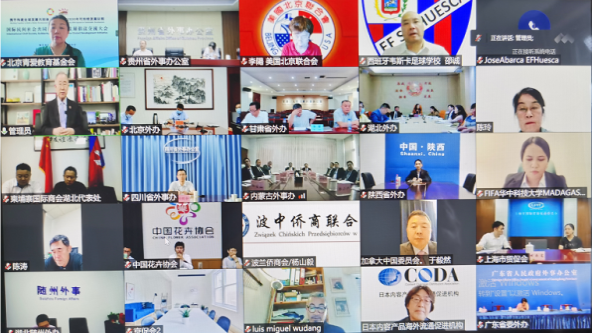
On August 12, 2022, the International Civil Society Solidarity Conference on the Global Development Initiative was held ...
Aug 14, 2022 Read Details
On September 10, at the invitation of the Chou Ta-Kuan Cultural and Educational Foundation in Taiwan, Mr. Clemens Goetz,...
Sep 11, 2025 Read Details
On November 7, the China Economic and Social Forum 2024 was held in Shanghai. Over 140 guests from organizations from 40...
Nov 15, 2024 Read Details


We reserve the right to correct and updateany content on this website without notice.
Introduction Articles of Association Organization Structure Milestones Rewards and Certificates Image Ambassadors Endowment Enterprises
Key Events Project News Media Report Announcement Partners Recent News

