


Public welfare hotline:+86-010-84404273
Email: apepcy@apepcy.org
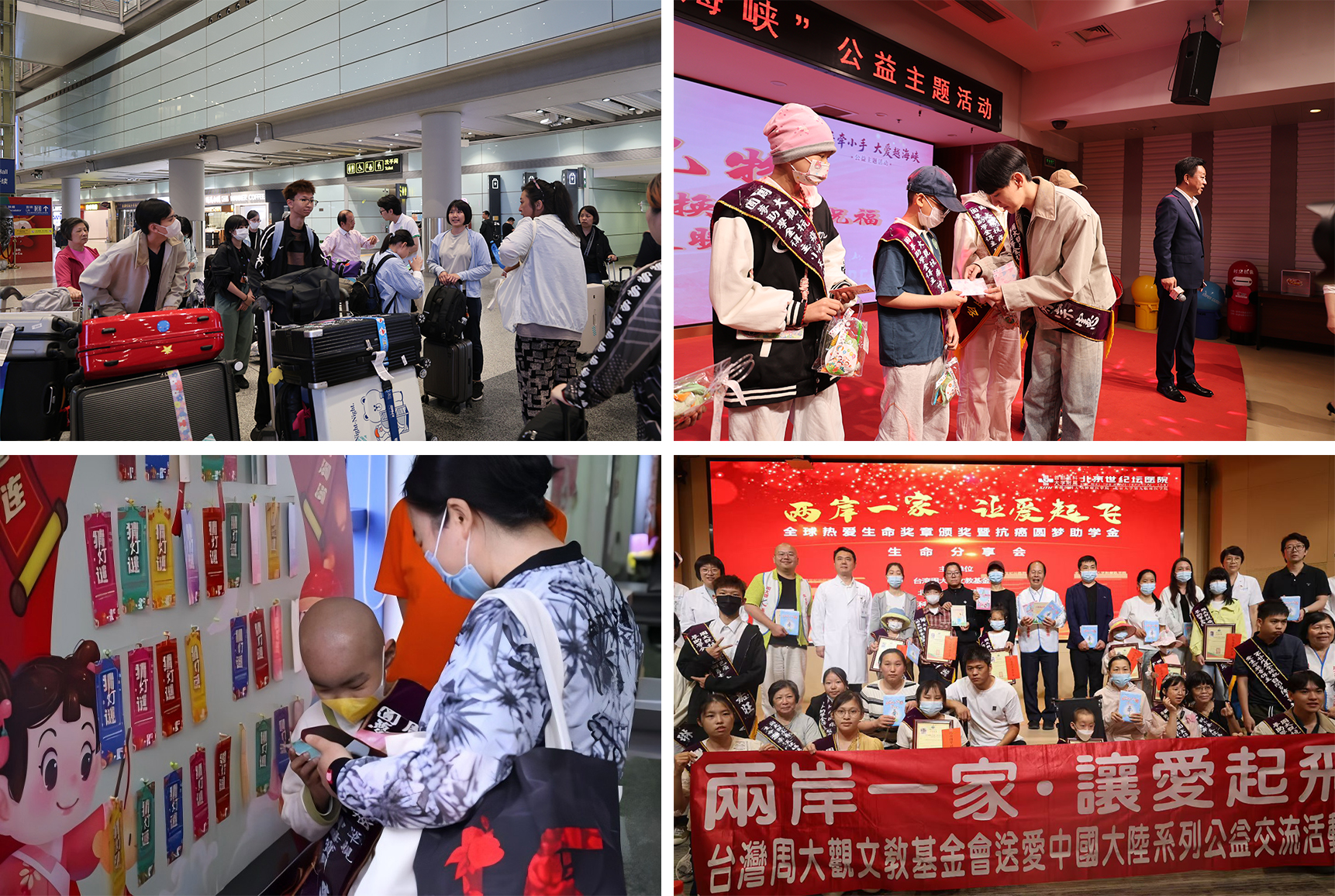
[Introduction] The strait has its tides, but great love knows no distance. As International Children’s Day approached, the cross-strait public welfare campaign for children’s health, "Unite as One Family Across the Straits, Give Love Wings to Fly: Big Hands Holding Little Hands, Great Love Across the Strait", opened warmly in Beijing from May 25 to 26, 2026. Young cancer survivors and public welfare partners from Taiwan traveled across mountains and seas to gather with physicians, caring individuals, and families of young patients in Beijing, united by love and connected heart to heart. This year, that love has grown new wings. The power of artificial intelligence has quietly woven itself into the effort, opening broader and deeper possibilities for protecting life. This is a heartfelt gift of great weight for the young warriors fighting illness on Children's Day, and it once again speaks to a simple yet profound truth: the motherland is the warmest embrace and the strongest support for every Chinese child.
I. A Mother's Twenty-Nine Years: Turning Pain into Love
The story begins in 1997. Chou Ta-Kuan, a young poet from Taiwan who battled cancer, left this world at the age of ten, leaving behind the words: "I still have one leg, I want to stand on the Earth." He was forever stilled in that summer. Guo Ying-Lan, who lost her beloved son, and her husband Chou Chin-Hua did not hide their tears. Instead, they let those tears flow into a river, and let that river nourish a far greater land. That same year, they founded the Chou Ta-Kuan Cultural and Educational Foundation in Taiwan in their son's name, transforming a mother's profound love for one child into a boundless compassion that has since watched over countless young warriors fighting for their lives.
Over twenty-nine years, this "extension of a mother's love" has reached more than eighty countries and regions around the world, with the Fervent Global Love of Lives Award presented to countless brave souls who, even while struggling on the edge of life and death, still lift their eyes to the stars. On this side of the strait, the Beijing Changier Education Foundation, as the sister foundation of the Chou Ta-Kuan Cultural and Educational Foundation on the Chinese mainland, has walked alongside it for many years, united in spirit and purpose, offering mutual support along the long road of nurturing the physical and mental health of young people, caring for life, and guarding the soul. Following the inaugural joint initiative by two sister foundations in the summer of 2025, when they came together to "bring love to Beijing Children's Hospital", the tide has risen once more on the eve of this year's Children's Day. Love has surged across the Taiwan Strait again, and this time, it carries something new in its embrace: the warmth of technology.
II. Beijing Children's Hospital: Two Generations of Cancer Warriors Celebrate Children's Day on a Rainbow Bridge

On the morning of May 25, a charity-themed event titled "Big Hands Holding Little Hands, Great Love Across the Strait" was held with warmth and care in the conference hall on the 12th floor of Beijing Children's Hospital, Capital Medical University, the National Center for Children's Health. The event was hosted by the Beijing Children's Health Foundation, the National Center for Children's Health, and Beijing Children's Hospital of Capital Medical University, co-organized by the Chou Ta-Kuan Cultural and Educational Foundation, the Beijing Changier Education Foundation, and the Children's Hospital Branch of the Chinese Hospital Association, and guided by the Cross-Strait Exchange Fund Management Committee of the Association for Relations Across the Taiwan Straits. The event was hosted by Zhu Jun, a senior CCTV anchor and Vice President of the Beijing Children's Health Foundation.
Huang Wentao, Director of the Cross-Strait Exchange Fund Management Committee of the Association for Relations Across the Taiwan Straits; Zhao Chengsong, Executive Vice President of Beijing Children's Hospital of Capital Medical University, the National Center for Children's Health, and President of the Children's Hospital Branch of the Chinese Hospital Association; Xu Xin, Assistant President of Beijing Children's Hospital and President of the Beijing Children's Health Foundation; Li Zhe, Deputy Director of the National Center for Pediatric Cancer Surveillance; Liu Yong, Deputy Secretary of the Discipline Inspection Commission of Beijing Children's Hospital and Supervisor-General of the Beijing Children's Health Foundation; Liu Fang, Secretary-General of the Beijing Children's Health Foundation; as well as Chou Chin-Hua, founder of the Chou Ta-Kuan Cultural and Educational Foundation in Taiwan, and Guo Ying-Lan, its President, along with other guests from both sides of the strait, attended the event.
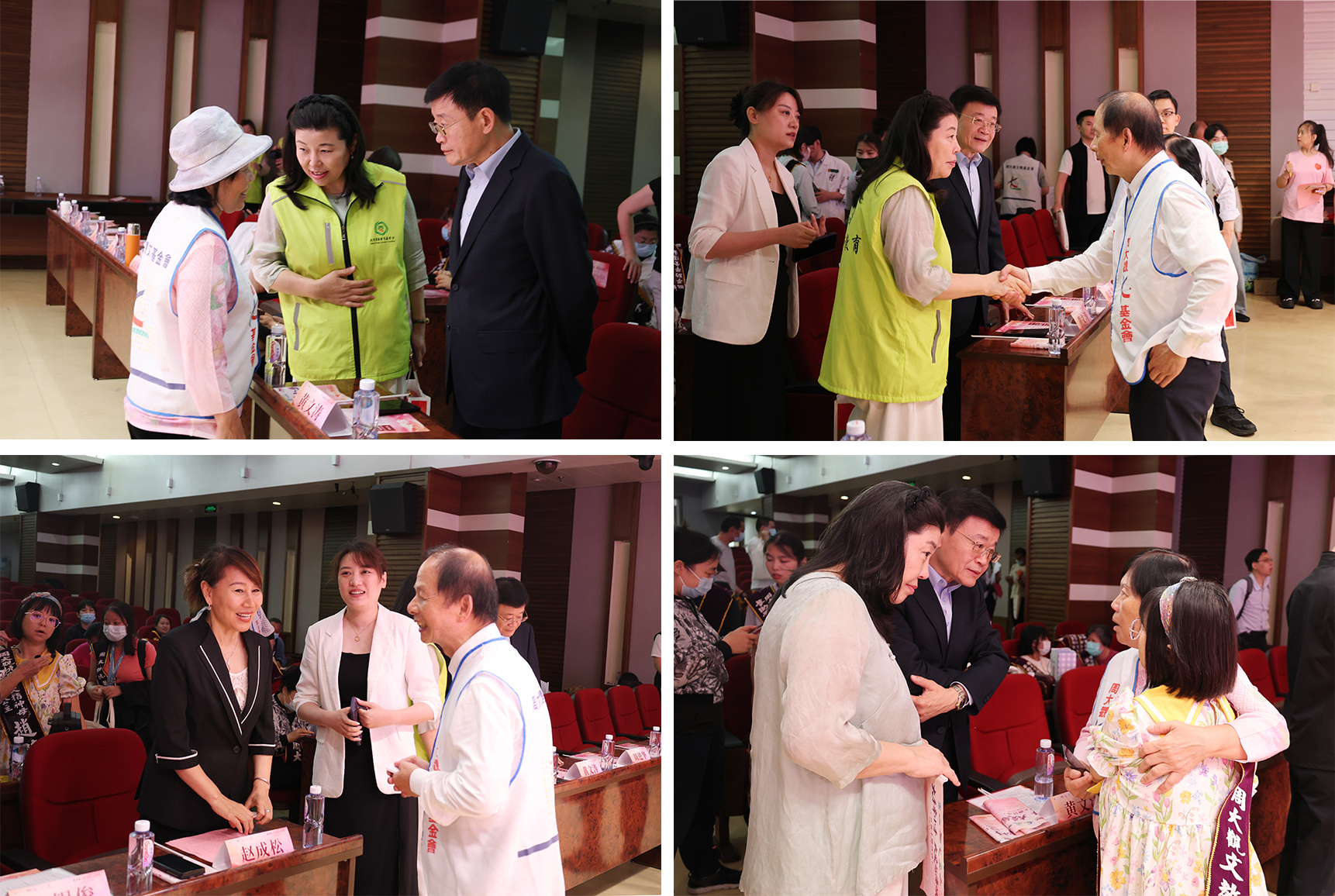
One detail at the event moved many to tears: whether it was the leaders from the Association for Relations Across the Taiwan Straits, the hospital president, or parents of young patients who had never met them before, everyone who spoke of Mr. Chou Chin-Hua and Ms. Guo Ying-Lan instinctively set aside formal titles such as "founder" or "chairman," and instead called them, with warmth and affection, "Papa Chou" and "Mama Chou". Chou Ta-Kuan is gone, but "Papa Chou" and "Mama Chou" remain. They are not just the parents of one child, but the shared parents of countless children lying in hospital beds and looking up at the stars.
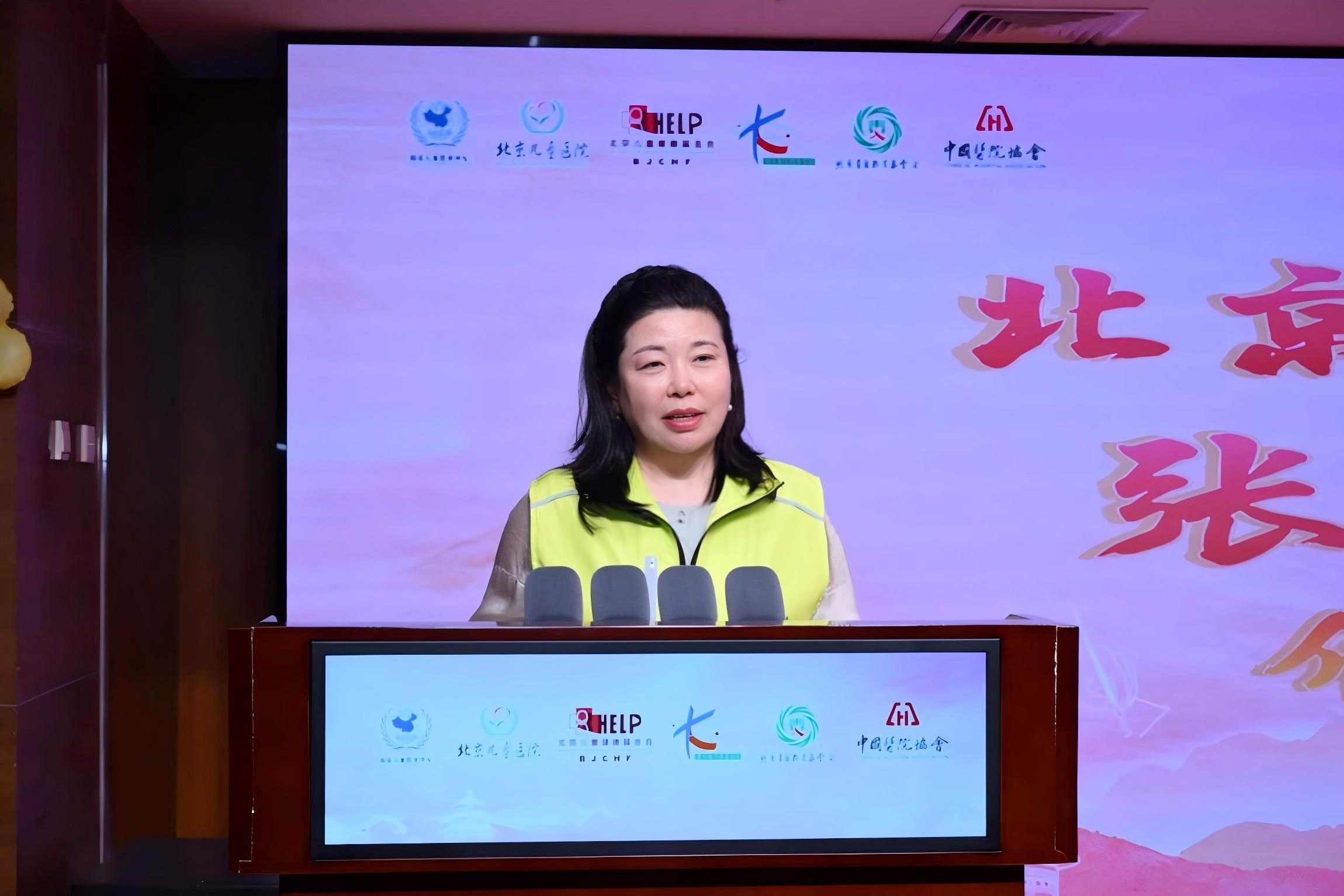
In her address, Zhang Yinjun, President of the Beijing Changier Education Foundation, opened with the name of a child, drawing the entire audience into a space of gentle yet powerful emotion: "Today, we gather here at Beijing Children's Hospital, united by love. I would like to begin by sharing with you the story of a little boy from Taiwan. His name was Chou Ta-Kuan. At the age of ten, he encountered a formidable "opponent" in his life. But he was not afraid. Instead, he picked up his pen and wrote a verse that moved the world: 'I still have one leg, I want to stand on the Earth. '"
President Zhang Yinjun then shifted her gaze to the group of young people from Taiwan present at the event. They had once faced the same "opponent" as Chou Ta-Kuan, yet today they stood before everyone healthy, radiant, and full of smiles and courage. "They are hope itself. Through their own stories, they have written the most moving sequel to Chou Ta-Kuan's poem: life can not only weather the storms, but rise again and shine."
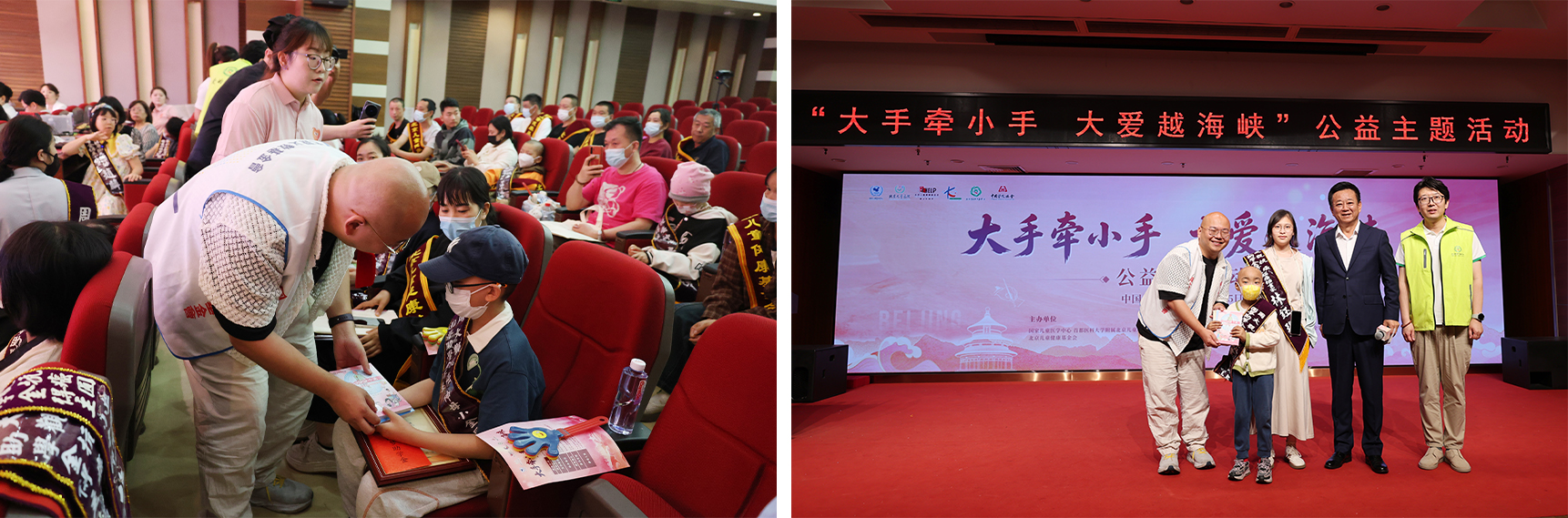
Book Donation Ceremony
President Zhang Yinjun then announced a special gift for Children's Day: the Beijing Changier Education Foundation and the Chou Ta-Kuan Cultural and Educational Foundation in Taiwan have joined hands to co-fund the republication and distribution of five books on the theme of life, namely I Still Have One Leg, The Little Star's Wish, Ta-Kuan, 3,499 Acts of Love, and He Once Came to This World. The five titles will be incorporated into the Changier "Education of Love" book series. "Today, we place this gift in the hands of every little hero, hoping it will shine as a light to accompany you through every moment when you need strength. Even as you fight a hard battle, you still have the right to hold on to the light; even as you weather the storms, the sun will always come after you persevere."
President Zhang Yinjun was invited to write a preface for this book series. This is not only an honor, but also a tangible embodiment of the shared spirit between the two sister foundations, carrying forward the "extended line of maternal love" that "Mama Chou" Guo Ying-Lan devoted her entire life to writing, and delivering it, through the power of words, into the hearts of every child fighting against fate in a hospital bed.
III. A Visit to iFLYTEK: Where AI Meets Care, and Technology Carries the Warmth of Maternal Love

During the event, the cross-strait public welfare delegations made a special visit to the iFLYTEK Beijing headquarters AI Experience Center, where they received a comprehensive professional guided tour and gained a close-up look at the in-depth applications of artificial intelligence in the fields of healthcare and education. Guided by a presenter, the delegation toured a range of cutting-edge products, including an intelligent exam-grading system, a personalized learning analytics platform, and a smart classroom interactive board. One exhibit that left a particularly strong impression on the guests was a "knowledge graph" system designed for primary and secondary school students. The system can precisely identify each student's level of mastery for every knowledge point, displaying the results visually in green, yellow, and red, while automatically pushing personalized micro-lessons and exercises. This brings audience-based education from an educational ideal to an accessible reality. iFLYTEK's smart education division has been deeply engaged in this field for over two decades. Its products now cover more than 60,000 schools across the country, serving over 160 million students, and have been deployed for AI-assisted grading in the gaokao across 14 provinces and in the senior high school entrance examination in more than 50 cities nationwide.
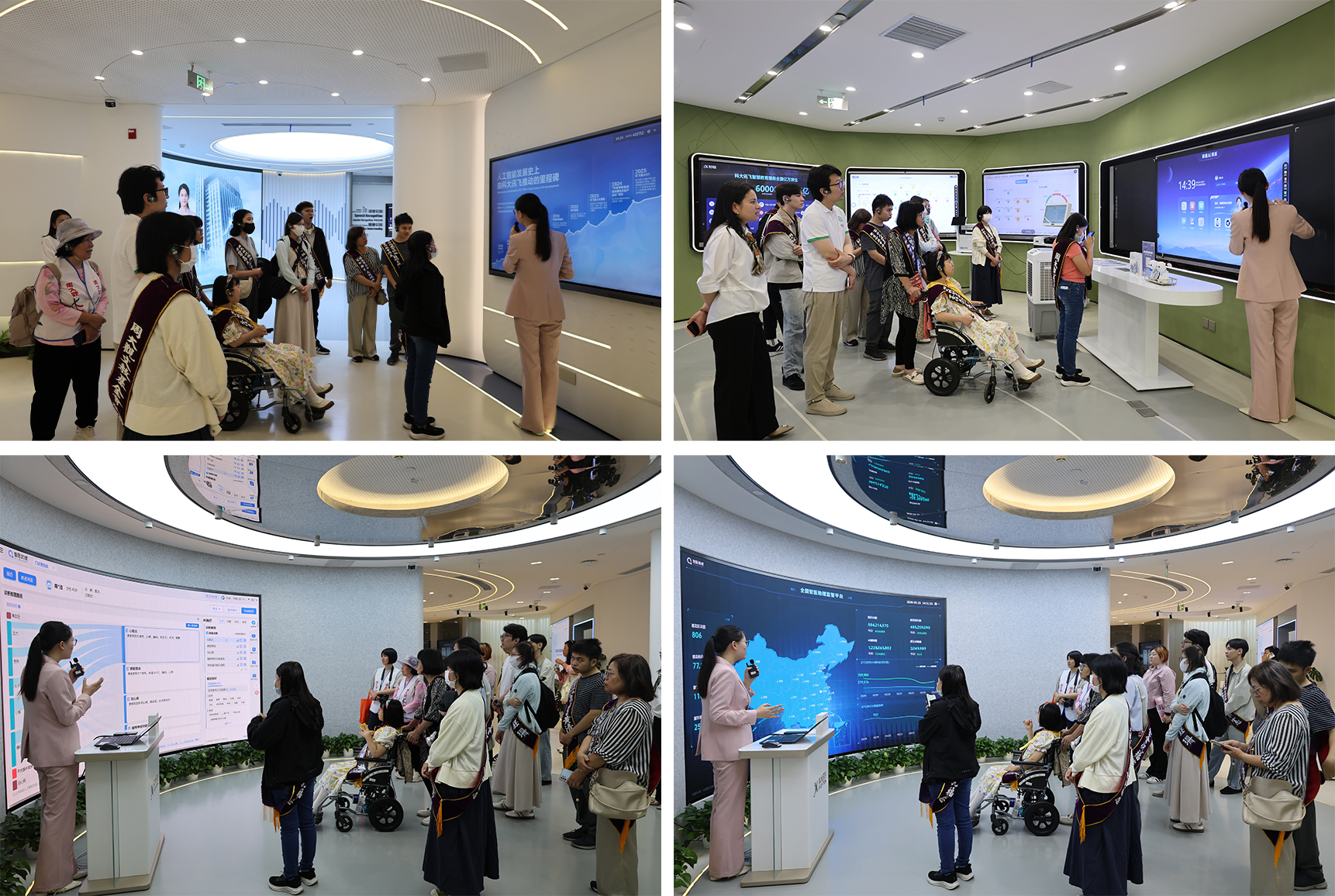
Guo Ying-Lan, known as "Mama Chou", who accompanied the delegation on the visit, said softly: "If this kind of technology had existed back then, it might have helped more children like Ta-Kuan learn more and leave more behind in the time they had." Her words gave voice to a mother's deepest regret, and also to the most fundamental value of AI in education. It is not merely a tool for efficiency, but a form of protection through technology: ensuring that no child is left behind, and that no life ends with unfinished dreams.
IV. AI For Young: Using Technology to Document the Motherland, Using Video to Connect the World

If the delegation's visit to iFLYTEK showed them the power of AI to safeguard children’s learning, then the "AI for Young" themed class held that same day at the Beijing Changier Education Foundation, titled "Empowering Youth with AI: Recording the Motherland Through Technology and Connecting the World Through Video", showed everyone the power of AI to safeguard children’s lives.

The presenter, Jingru, is a youth AI literacy trainer with a remarkable personal life story. Years earlier, she went through what she describes as a "factory reset" in her own life. During a long period of recovery, she picked up a brush and began creating traditional Chinese ink paintings for a young German-Chinese girl living with depression and autism. Once a week, session by session, the child who had once been silent and volatile began to slowly trace complete shapes on the paper. The smoke rising from a chimney turned into rainbow colors. "What was once formless inside," she said, "had grown into a whole and complete world." More than a year later, the little girl recovered. That moment, Jingru said, brought her a realization: "Someone who has been through a 'factory reset' can draw on the power of rebirth in countless ways to help others. Your strength is limitless."

Later, she grafted this belief in "using one life to inspire another" onto the wings of artificial intelligence. She taught herself AI tools and guided children as young as four years old in using AI to create short films. Their works competed alongside those of adult directors at the Beijing International Film Festival, with 27 films making it to the finals and 5 winning awards. Seated on the judging panel were China's top 50 directors alongside children who had just completed the very first film of their lives.
In class, staff members from the two foundations sat side by side with young cancer fighters from Taiwan. Under Jingru’s thoughtful guidance, they explored the limitless possibilities of AI tools and saw how these tools could capture the richness of life, the depth and subtlety of emotion, and the vibrant strength of the motherland in every flowing frame.


As Jingru said at the close of the session: "A person's identity, or how one defines oneself, is not fixed. Illness and hardship do not define who you are. AI gave children the opportunity to express themselves, and expression is the most powerful proof of existence." These words echo across time, resonating with the lines Chou Ta-Kuan wrote twenty-nine years ago.
V. Beijing Century Altar Hospital: Hair as a Gift, Love Beyond Words

On the morning of May 26, the second stop of the charity activity took place at the lecture hall on the fifth floor of the inpatient building of Beijing Century Altar Hospital, affiliated with Capital Medical University. The event, themed "Unite as One Family Across the Straits, Give Love Wings to Fly", was a ceremony presenting the Fervent Global Love of Lives Award, combined with a life-sharing session for cancer survivors receiving dream-fulfillment scholarships. It was jointly organized by the Chou Ta-Kuan Cultural and Educational Foundation, the Beijing Changier Education Foundation, and Beijing Century Altar Hospital affiliated with Capital Medical University, and was hosted by Du Ye, Deputy Director of Beijing Century Altar Hospital.
The event opened with two video segments that drew the audience into a heartfelt journey across time: one chronicling the nearly three decades of the Chou Ta-Kuan Cultural and Educational Foundation's dedication to the cause of cherishing life, and the other tracing the 111-year legacy of Beijing Century Altar Hospital. Two video segments, two forms of unwavering dedication, quietly converging within the same lecture hall.

The ceremony then moved into a moment of solemnity and warmth as the awards were presented. Chou Chin-Hua, founder of the Chou Ta-Kuan Cultural and Educational Foundation in Taiwan, and Wang Changkun, Director of the International Affairs Department of the Beijing Changier Education Foundation, jointly presented the Fervent Global Love of Lives Award to Zhang Qian, Deputy Secretary of the Party Committee and President of Beijing Century Altar Hospital. This award honors President Zhang Qian for her years of dedicated service in protecting lives with the compassion of a healer, and pays the deepest tribute to the countless medical workers on the front lines of healthcare. In her acceptance speech, President Zhang Qian spoke with deep emotion, saying that a hospital must not only tear down its physical walls but also open the hearts of its medical staff, so that doctors and patients can truly close the distance between them.


The ceremony then moved into a warm presentation of the Cancer Survivors' Dream-Fulfillment Scholarship awards and a book donation, during which volumes embodying the spirit of Chou Ta-Kuan were solemnly placed into the hands of young patients and their families. On behalf of the hospital, Wu Wanshui, Director of the Pediatrics Department at Beijing Century Altar Hospital, presented two heartfelt gifts to the young cancer survivors from Taiwan: a panda embroidery fan, symbolizing friendship, harmony, and reunion across the Taiwan Strait; and a persimmon-shaped moxa mallet, whose name carries the auspicious meaning of "may all things go as wished", expressing the hope that every warrior of life may enjoy peace and good health.
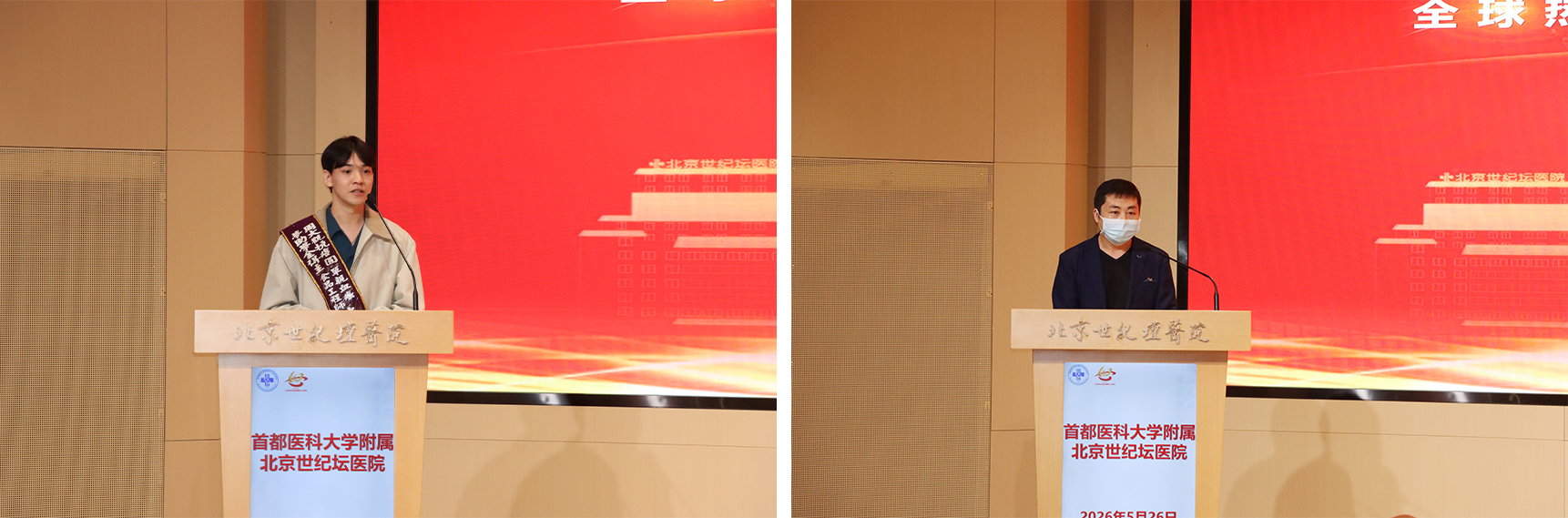
In the life-sharing session between cancer survivors from both sides of the Taiwan Strait, a student named Cai Zongjian (pseudonym) from Kaohsiung, Taiwan, took to the stage to share his personal journey after being diagnosed with acute myeloid leukemia, recounting how he had gone to the hospital alone and undergone chemotherapy and bone marrow transplantation. He said it was the companionship and encouragement of "Papa Chou" and "Mama Chou" that taught him to "fight cancer with positivity and courage". The father of Liu Jiajia (pseudonym), a young cancer patient from Beijing, also took to the stage and spoke in plain, heartfelt words that gave voice to the shared feelings of every family touched by cancer: "It felt like the sky had fallen. We couldn't believe it, couldn't accept it, but had no choice but to face it." In the audience, the families of young patients listened with tears in their eyes, nodding again and again.

Yet the moment that moved the entire audience most deeply that day was a ceremony known as the "Love Donation". Wang Chong, Deputy Director of the Nursing Department at Beijing Century Altar Hospital, and nurse Geng Haimei had quietly been growing their hair for a long time in preparation for this day. They cut off the hair they had carefully grown over a long period of time and solemnly donated it. The hair will be sent to Taiwan to be made into wigs for patients fighting cancer who have lost their hair due to chemotherapy. A single lock of hair, crossing the strait, gently binds the warmth of mainland medical workers to the dignity of cancer patients in Taiwan. This silent gift is also the deepest tribute to all those who fight illness with their mortal bodies.

Speaking with deep emotion on stage, Chou Chin-Hua noted that approximately 50 percent of elementary school students in Taiwan have participated in hair donation initiatives, and that around 40 centimeters of hair can be made into one wig for a young cancer warrior. "This is one of the most moving moments I have experienced in nearly thirty years. Medical workers are closest to suffering and pain every day, and they feel it most deeply. The love they give is the kind that truly understands you."
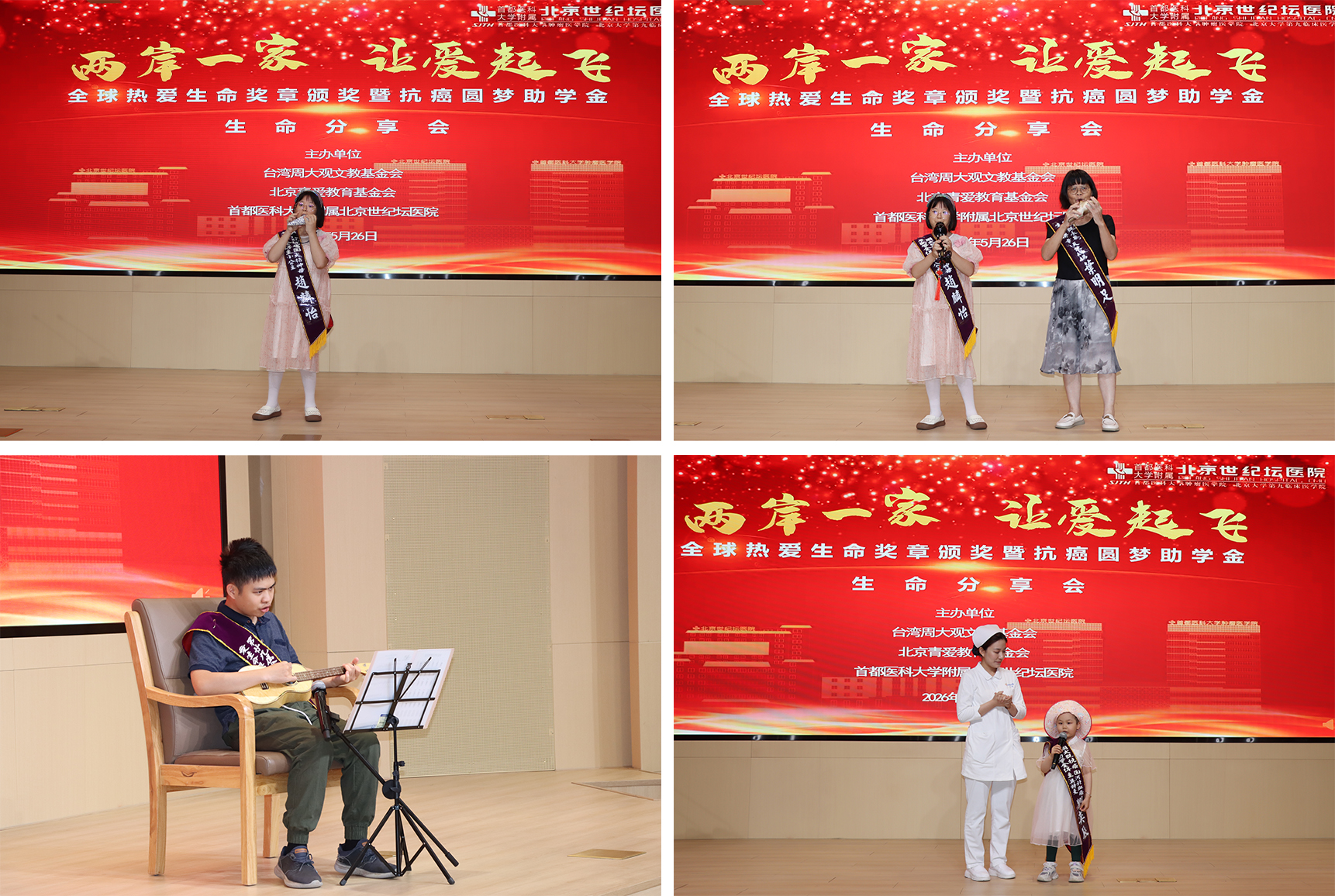
As the event drew to a close, Zhao Yiyi (pseudonym), a young cancer survivor from Taiwan, played the hulusi with deep feeling, the melodious notes drifting softly through the auditorium. Liu Jiajia (pseudonym), a young warrior of life from Beijing, then took to the stage and sang "Selfless Love", with the lyrics "A mother's love is as vast as the sky". As voices and tears mingled, the hearts of people on both sides of the Taiwan Strait were drawn close together in that moment. In the group photo, every face wore a smile, and every pair of eyes held a quiet light.
VI. Epilogue: The Two Wings of Love: Tradition and Technology, Together Upholding Life
Over the course of two days, a vivid portrait of love took shape: sometimes it was a mother's light that never went out across twenty-nine years; sometimes it was a gaze of devotion toward a child hidden behind a line of code; sometimes it was a lock of donated hair, a book given away, or a song sung at a patient's bedside.
Behind all of this love, there is a greater embrace that has always remained open: the embrace of the motherland. It guards children's bodies through medicine, nurtures their minds through education, secures their futures through technology, and preserves their roots through culture.
The strait has its tides, but great love knows no distance. People on both sides of the Taiwan Strait are one family. Let love take flight.
This page has just been written, the ink still fresh. Please turn the page. In the next chapter, we await you beneath the red walls of the Palace Museum and beside the flying apsaras of Dunhuang.

From May 27 to 31, Zhang Qingli, Vice Chairman of the 13th National Committee of the Chinese People's Political Consulta...
Jun 13, 2024 Read Details
On September 25, the APEPCY Hegang Base in Heilongjiang Province was unveiled, and the first batch of ten Changier Huts ...
Sep 26, 2023 Read Details
President Zhang Yinjun delivers a video speech On November 14, the unveiling ceremony of the 213th Maternal Love Academ...
Nov 17, 2024 Read Details


We reserve the right to correct and updateany content on this website without notice.
Introduction Articles of Association Organization Structure Milestones Rewards and Certificates Image Ambassadors Endowment Enterprises
Key Events Project News Media Report Announcement Partners Recent News

